Alloying Elements in Aluminium Pressure Die Casting (PDC): Roles, Advantages & Limitations
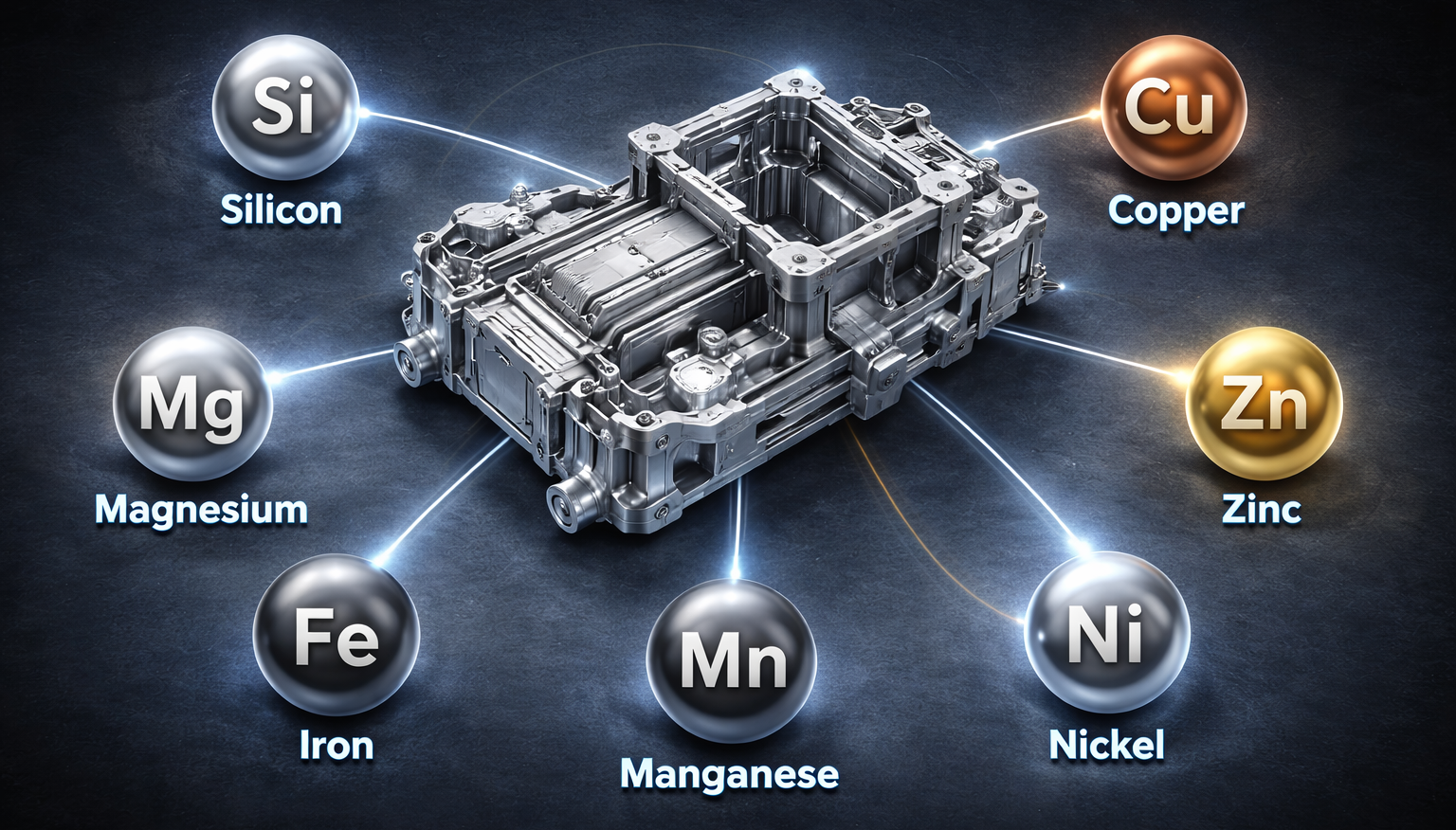
Alloying Elements in Aluminium Pressure Die Casting (PDC)
Aluminium pressure die casting (PDC) alloys are not pure aluminium. They are carefully engineered Al-Si based alloys containing controlled additions of silicon, copper, magnesium, zinc, iron, manganese, and trace modifiers.
The information in this article is based on:
- Aluminum Association alloy designation system
- NADCA (North American Die Casting Association) technical publications
- ASM International handbooks
- EN 1706 (European aluminium casting alloy standard)
This blog explains:
- Why each alloying element is added
- Its metallurgical function
- Advantages in high pressure die casting
- Limitations and trade-offs
Why Aluminium Alloys Are Used in PDC
Primary PDC alloys such as:
- A380 (AlSi8Cu3)
- ADC12
- EN AC-46000
- A383
- A413
are based on Al-Si systems because silicon dramatically improves castability.
Pure aluminium is:
- Too ductile
- Too prone to shrinkage
- Poor in fluidity for thin-wall die casting
Alloying corrects these limitations.
Major Alloying Elements in Aluminium PDC Alloys
1. Silicon (Si)
Typical Range: 7% – 12% (can go higher in specific alloys like A413)
Why It Is Added
Silicon is the most important alloying element in aluminium die casting.
Metallurgical Role
- Improves fluidity of molten metal
- Reduces solidification shrinkage
- Enhances castability of thin sections
- Improves wear resistance
Advantages
- Excellent mold filling in high-pressure die casting
- Reduced hot tearing
- Good dimensional stability
- Improved corrosion resistance (compared to Al-Cu rich alloys)
Disadvantages
- Excess silicon reduces ductility
- Can increase brittleness at very high percentages
- Lower machinability at higher Si levels
Silicon is the backbone of all commercial aluminium PDC alloys.
2. Copper (Cu)
Typical Range: 1% – 4% (common in A380, ADC12)
Why It Is Added
Copper increases strength and hardness.
Metallurgical Role
- Forms strengthening intermetallic phases
- Improves high-temperature mechanical strength
Advantages
- Higher tensile strength
- Improved hardness
- Better elevated-temperature performance
Disadvantages
- Reduced corrosion resistance
- Increased susceptibility to stress corrosion cracking
- Lower ductility compared to low-copper alloys
Alloys with higher copper are often selected for automotive housings and structural applications requiring strength.
3. Magnesium (Mg)
Typical Range: 0.1% – 0.5% in most PDC alloys
Why It Is Added
Magnesium enables precipitation hardening and increases strength.
Metallurgical Role
- Forms Mg2Si strengthening phases
- Increases hardness and yield strength
Advantages
- Improved strength-to-weight ratio
- Better machinability
- Contributes to age-hardening response
Disadvantages
- Reduced corrosion resistance at higher levels
- Increased oxidation during melting
- Can reduce fluidity slightly
Magnesium is carefully controlled to balance strength and castability.
4. Zinc (Zn)
Typical Range: Up to 3% (varies by standard)
Why It Is Added
Zinc contributes to strength and improves castability in some compositions.
Metallurgical Role
- Solid solution strengthening
- Can enhance pressure tightness
Advantages
- Increased strength
- Often improves dimensional stability
Disadvantages
- Excess zinc may reduce corrosion resistance
- Can increase hot cracking risk if poorly controlled
Zinc is usually a secondary strengthening element in aluminium PDC alloys.
5. Iron (Fe)
Typical Range: 0.6% – 1.3% (controlled range)
Why It Is Added
Iron is intentionally added in die casting alloys to prevent die soldering.
Metallurgical Role
- Reduces adhesion of molten aluminium to steel dies
- Improves die release
Advantages
- Prevents die sticking
- Improves die life
- Enhances production stability
Disadvantages
- Excess iron forms brittle intermetallic platelets
- Reduces ductility and impact strength
Iron is one of the most critical elements in high pressure die casting operations.
6. Manganese (Mn)
Typical Range: 0.2% – 0.6%
Why It Is Added
Manganese modifies iron-based intermetallic structures.
Metallurgical Role
- Converts harmful β-Fe phases into less detrimental α-Fe phases
Advantages
- Improves ductility
- Reduces brittleness caused by iron
- Enhances corrosion resistance
Disadvantages
- Excess can reduce fluidity
Manganese is often used to balance iron content.
7. Nickel (Ni) – Specialized Applications
Typical Range: Small additions in heat-resistant alloys
Why It Is Added
Improves high-temperature strength.
Advantages
- Better performance in engine components
- Improved thermal stability
Disadvantages
- Increases cost
- Can reduce ductility
Nickel-containing alloys are often used in automotive powertrain components.
Trade-Offs in Aluminium PDC Alloy Design
Aluminium die casting alloy selection always involves compromise:
| If You Increase | You Improve | But You Reduce |
|---|---|---|
| Silicon | Fluidity & Wear Resistance | Ductility |
| Copper | Strength | Corrosion Resistance |
| Magnesium | Hardness | Oxidation Resistance |
| Iron | Die Life | Impact Strength |
This is why alloys like A380 / ADC12 are widely adopted — they offer a balanced composition optimized for high pressure die casting.
Common Aluminium PDC Alloys & Their Composition Philosophy
- A380 / EN AC-46000 → Balanced strength, castability, cost efficiency
- ADC12 → Excellent castability, good mechanical properties
- A413 → High silicon for superior fluidity and pressure tightness
- A383 → Improved hot cracking resistance
These compositions are defined by international standards such as:
- Aluminum Association
- ASTM B85
- EN 1706
Conclusion
Alloying elements in aluminium pressure die casting are not added randomly. Each element serves a specific metallurgical purpose:
- Silicon enables castability.
- Copper and magnesium provide strength.
- Iron protects dies.
- Manganese improves structural integrity.
- Zinc and nickel fine-tune performance.
The success of high pressure die casting (HPDC) depends on achieving the correct balance between:
- Fluidity
- Strength
- Corrosion resistance
- Ductility
- Die life
Understanding these alloying principles is essential for selecting the right material for automotive, electronics, industrial, and structural aluminium die casting applications.
Technical references used in verification:
- Aluminum Association Alloy Designation System
- NADCA Product Specification Standards for Die Castings
- ASM Handbook: Volume 2 – Properties and Selection of Nonferrous Alloys
- EN 1706 Aluminium and Aluminium Alloys – Castings – Chemical Composition
- ASTM B85 Standard Specification for Aluminium-Alloy Die Castings