Aluminium Die Casting vs Other Die Casting Metals
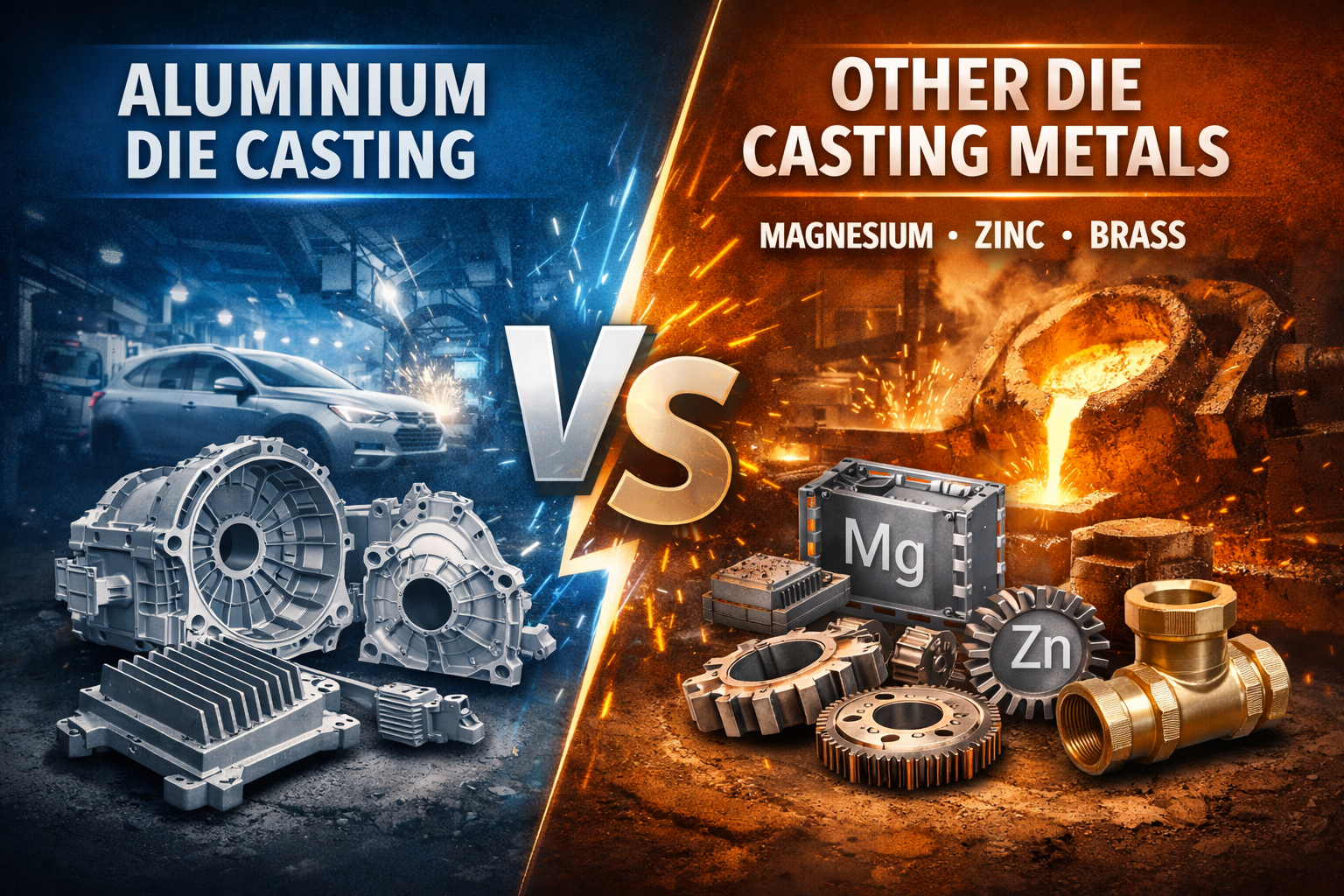
Aluminium Die Casting vs Other Die Casting Metals
Aluminium vs Magnesium vs Zinc vs Brass Properties, Cost, Quality & Applications
Die casting is a high-pressure metal forming process used exclusively for non-ferrous metals. While aluminium die casting dominates automotive and industrial manufacturing, magnesium, zinc, and brass are also widely die cast for specific engineering requirements.
This blog provides a technically accurate, industry-aligned comparison of the most commonly used die casting metals, focusing on material behavior, cost structure, dimensional capability, surface finish, and real-world applications.
What Is Die Casting?
Die casting is a manufacturing process in which molten metal is injected into a reusable steel die under high pressure, typically ranging from 1,000 to 20,000 psi, depending on the metal and machine type.
Only low-melting-point non-ferrous metals are suitable for die casting due to tooling life and thermal constraints. These include:
- Aluminium alloys
- Magnesium alloys
- Zinc alloys
- Copper-based alloys (brass, limited use)
Aluminium Die Casting The Industry Standard
Aluminium die casting accounts for the largest share of global die casting production. It offers the best balance of strength, weight, corrosion resistance, thermal performance, and scalability.
Key Advantages of Aluminium Die Casting
- High strength-to-weight ratio
- Excellent corrosion resistance
- Good thermal and electrical conductivity
- Capability to produce medium to large components
- Cost efficiency at medium to high production volumes
Common Aluminium Die Casting Alloys
- A380 / ADC12 – general-purpose, automotive dominant
- A383 – improved fluidity for thin-wall components
- A360 – enhanced corrosion resistance
Aluminium die casting is widely used in automotive, EV, industrial machinery, and power electronics.
Aluminium Die Casting vs Magnesium Die Casting
Core Material Difference
- Aluminium: Higher strength, better corrosion resistance
- Magnesium: Lowest density structural metal, excellent machinability
Technical Comparison
| Property | Aluminium Die Casting | Magnesium Die Casting |
|---|---|---|
| Density | ~2.7 g/cm³ | ~1.8 g/cm³ |
| Strength | High | Medium |
| Corrosion Resistance | Good to excellent | Requires surface treatment |
| Machinability | Good | Excellent |
| Die Life | Longer | Shorter |
| Raw Material Cost | Medium | Higher |
| Typical Part Size | Medium to large | Small to medium |
Engineering Verdict
Magnesium die casting is selected for aggressive weight reduction, while aluminium die casting remains superior for structural and load-bearing applications.
Aluminium Die Casting vs Zinc Die Casting
Core Material Difference
- Aluminium: Stronger, higher temperature capability
- Zinc: Superior surface finish and dimensional precision
Technical Comparison
| Property | Aluminium Die Casting | Zinc Die Casting |
|---|---|---|
| Melting Temperature | ~660°C | ~420°C |
| Surface Finish | Very good | Excellent |
| Minimum Wall Thickness | Moderate | Extremely thin |
| Dimensional Tolerance | Tight | Very tight |
| Tool Life | Good | Very long |
| Production Speed | High | Very high |
| Typical Part Size | Medium to large | Small to medium |
Engineering Verdict
Zinc die casting is ideal for small, intricate, high-precision components, while aluminium is preferred for larger, mechanically demanding parts.
Aluminium Die Casting vs Brass Die Casting
About Brass Die Casting
Brass die casting uses copper–zinc alloys and is applied where high strength, wear resistance, and electrical conductivity are required. Due to high melting temperatures and severe tool wear, brass die casting is limited to niche applications.
Technical Comparison
| Property | Aluminium Die Casting | Brass Die Casting |
|---|---|---|
| Base Metal | Aluminium alloys | Copper–zinc alloys |
| Melting Temperature | ~660°C | ~900–940°C |
| Mechanical Strength | High | Very high |
| Wear Resistance | Moderate | Excellent |
| Electrical Conductivity | Good | Excellent |
| Tool Wear | Moderate | Severe |
| Material Cost | Medium | Very high |
| Production Volume | Medium to high | Low to medium |
Engineering Verdict
Brass die casting is used only when mechanical strength and conductivity outweigh tooling cost and production efficiency.
Cost Comparison of Die Casting Metals
| Metal | Tooling Cost | Material Cost | Cost per Part (High Volume) |
|---|---|---|---|
| Aluminium | High | Medium | Low |
| Magnesium | High | High | Medium |
| Zinc | Medium | Low | Very low |
| Brass | Very high | Very high | High |
Cost efficiency is one of the key reasons aluminium die casting dominates automotive and industrial markets.
Quality & Performance Comparison
| Property | Aluminium | Magnesium | Zinc | Brass |
|---|---|---|---|---|
| Mechanical Strength | ⭐⭐⭐⭐ | ⭐⭐⭐ | ⭐⭐ | ⭐⭐⭐⭐⭐ |
| Weight Efficiency | ⭐⭐⭐ | ⭐⭐⭐⭐ | ⭐ | ⭐⭐ |
| Surface Finish | ⭐⭐⭐⭐ | ⭐⭐⭐ | ⭐⭐⭐⭐⭐ | ⭐⭐⭐⭐ |
| Wear Resistance | ⭐⭐⭐ | ⭐⭐ | ⭐⭐ | ⭐⭐⭐⭐⭐ |
| Thermal Stability | ⭐⭐⭐⭐ | ⭐⭐⭐ | ⭐⭐ | ⭐⭐⭐⭐⭐ |
Typical Applications by Metal
Aluminium Die Casting
- Automotive engine and transmission housings
- EV motor and battery enclosures
- Industrial machinery components
- Power electronics housings
Magnesium Die Casting
- Consumer electronics frames
- Aerospace brackets
- Lightweight automotive components
Zinc Die Casting
- Precision connectors and housings
- Locks, hinges, fasteners
- Consumer and electrical components
Brass Die Casting
- Electrical terminals and connectors
- Valves and plumbing components
- High-wear mechanical parts
Final Conclusion
While aluminium, magnesium, zinc, and brass can all be die cast, each metal serves a specific engineering purpose:
- Aluminium → best overall balance of strength, cost, and scalability
- Magnesium → extreme lightweighting
- Zinc → precision and surface finish
- Brass → strength, wear resistance, conductivity
For automotive, EV, and industrial manufacturing, aluminium die casting remains the most versatile and commercially viable die casting solution.