Cold Chamber vs Hot Chamber Die Casting: Key Differences Explained
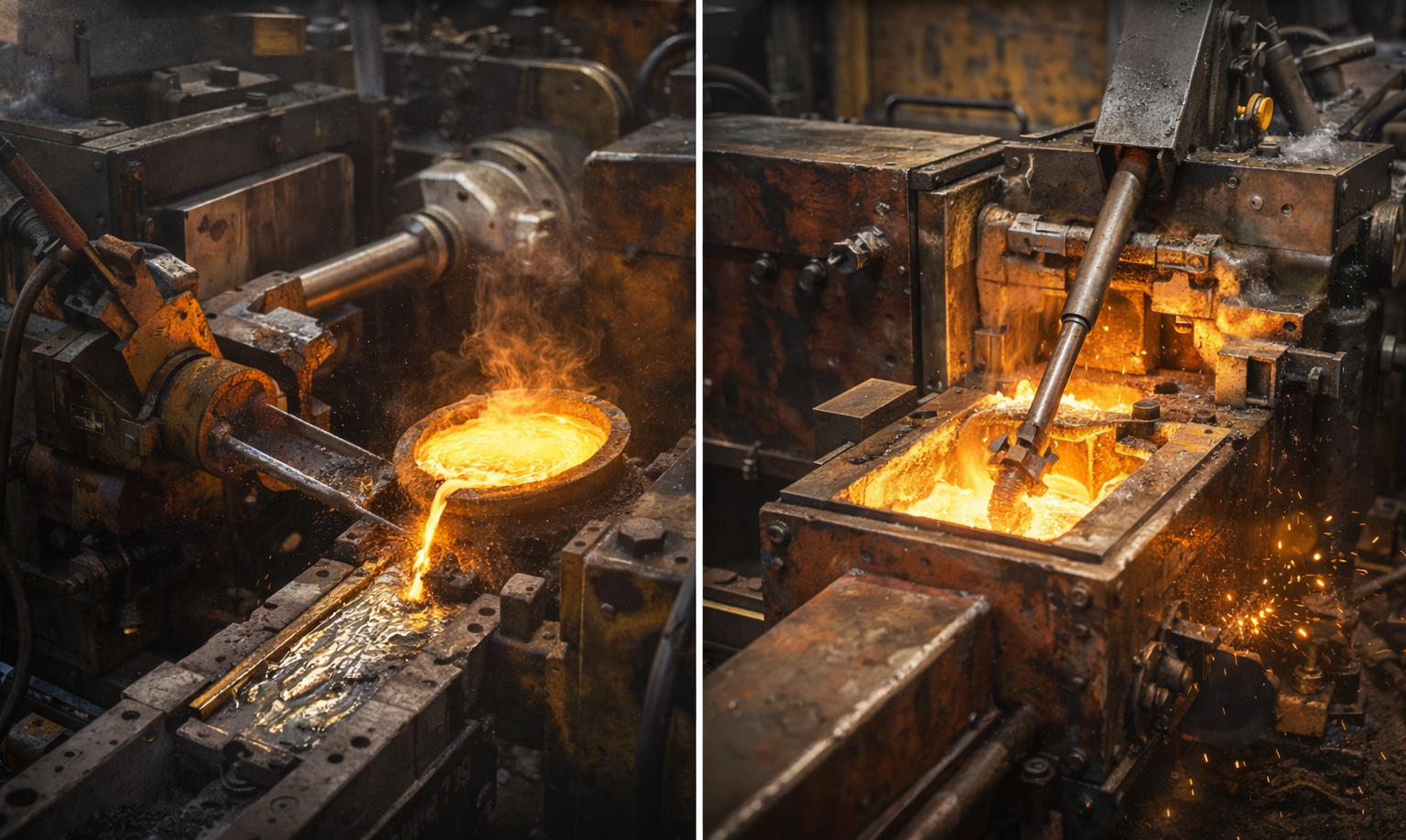
Cold Chamber vs Hot Chamber Die Casting
Process Differences, Suitable Metals, Cost, Quality & Applications
Die casting is one of the most widely used high-pressure metal casting processes for producing dimensionally accurate, high-volume non-ferrous components.
Within die casting, two primary process variants exist:
- Hot chamber die casting
- Cold chamber die casting
While both operate on the same fundamental principle injecting molten metal into a steel die under high pressure their process design, metal compatibility, production speed, and cost structure differ significantly.
Overview of Die Casting Chambers
The distinction between hot chamber and cold chamber die casting lies in how molten metal is handled and injected into the die.
| Parameter | Hot Chamber Die Casting | Cold Chamber Die Casting |
|---|---|---|
| Injection System | Submerged in molten metal | Separate shot sleeve |
| Metal Handling | Internal to the machine | Ladled externally |
| Cycle Time | Faster | Slower |
| Operating Temperature | Lower | Higher |
| Suitable Metals | Low-melting alloys | Higher-melting alloys |
What Is Hot Chamber Die Casting?
Hot chamber die casting integrates the injection system directly into a molten metal bath. The gooseneck and plunger mechanism remain constantly submerged in molten metal.
How Hot Chamber Die Casting Works
- Molten metal is held in an integrated furnace
- Injection system is submerged in the melt
- Metal is injected into the die under high pressure
- Part solidifies and is ejected
Because the metal is always molten and ready for injection, cycle times are extremely short.
Metals Used in Hot Chamber Die Casting
Only low-melting-point, non-corrosive metals are suitable:
- Zinc alloys (Zamak series)
- Magnesium alloys (in controlled environments)
- Lead and tin alloys (now limited due to regulations)
❌ Aluminium and brass cannot be used in hot chamber die casting because they attack and erode the submerged injection components.
Advantages of Hot Chamber Die Casting
- Very high production speed
- Excellent surface finish
- Tight dimensional tolerances
- Long die life
- Lower per-part cost at high volumes
Limitations of Hot Chamber Die Casting
- Restricted to low-melting alloys
- Smaller part sizes
- Lower mechanical strength compared to aluminium
What Is Cold Chamber Die Casting?
In cold chamber die casting, molten metal is melted in a separate furnace and then ladled into a shot sleeve for each injection cycle.
How Cold Chamber Die Casting Works
- Metal is melted in an external furnace
- Molten metal is poured into the shot sleeve
- A hydraulic plunger injects metal into the die
- Part solidifies and is ejected
Because the injection system is not submerged, cold chamber machines can handle higher-temperature and more aggressive alloys.
Metals Used in Cold Chamber Die Casting
Cold chamber die casting is used for:
- Aluminium alloys (A380, ADC12, A383)
- Magnesium alloys (larger components)
- Copper-based alloys (brass, limited use)
Aluminium die casting is almost exclusively performed using the cold chamber process.
Advantages of Cold Chamber Die Casting
- Suitable for high-strength alloys
- Capable of producing large structural components
- Better mechanical properties than zinc parts
- Wider alloy selection
Limitations of Cold Chamber Die Casting
- Longer cycle time
- Higher operating cost
- Increased metal handling losses
- Slightly lower surface finish than zinc hot chamber parts
Cold Chamber vs Hot Chamber Die Casting: Technical Comparison
| Feature | Hot Chamber | Cold Chamber |
|---|---|---|
| Typical Metals | Zinc, Magnesium | Aluminium, Magnesium, Brass |
| Melting Temperature | Low | Medium to High |
| Injection Speed | Very High | High |
| Cycle Time | Short | Longer |
| Part Size | Small to Medium | Medium to Large |
| Mechanical Strength | Low to Medium | Medium to High |
| Tool Wear | Low | Higher |
| Production Volume | Very High | Medium to High |
Cost Comparison
| Cost Factor | Hot Chamber | Cold Chamber |
|---|---|---|
| Machine Cost | Lower | Higher |
| Energy Consumption | Lower | Higher |
| Tool Life | Longer | Shorter |
| Cost per Part (High Volume) | Very Low | Low |
Typical Industrial Applications
Hot Chamber Die Casting Applications
- Electrical connectors
- Consumer hardware
- Locks, hinges, fasteners
- Small automotive components
Cold Chamber Die Casting Applications
- Automotive engine and transmission housings
- EV motor and battery enclosures
- Industrial machinery components
- Structural aluminium parts
Which Die Casting Process Should You Choose?
The choice between hot chamber and cold chamber die casting depends primarily on:
- Metal alloy selection
- Mechanical performance requirements
- Component size
- Production volume
- Cost targets
Quick Selection Guide
- Choose hot chamber die casting for zinc, high-volume, precision parts
- Choose cold chamber die casting for aluminium, strength-critical components
Final Conclusion
Both hot chamber and cold chamber die casting are essential to modern manufacturing, but they serve distinctly different roles.
- Hot chamber die casting excels in speed, surface finish, and high-volume zinc production
- Cold chamber die casting dominates aluminium and structural applications requiring strength and durability
Understanding these differences ensures optimal material selection, cost efficiency, and product performance.