Effect of Iron Content in Aluminium Die Casting Alloys
•Impressions Team
Aluminium Die CastingIron Content Aluminium AlloyHPDC MetallurgyA380 AlloyADC12 AlloyDie Casting DefectsIntermetallic PhasesFoundry EngineeringMetal Casting Technology
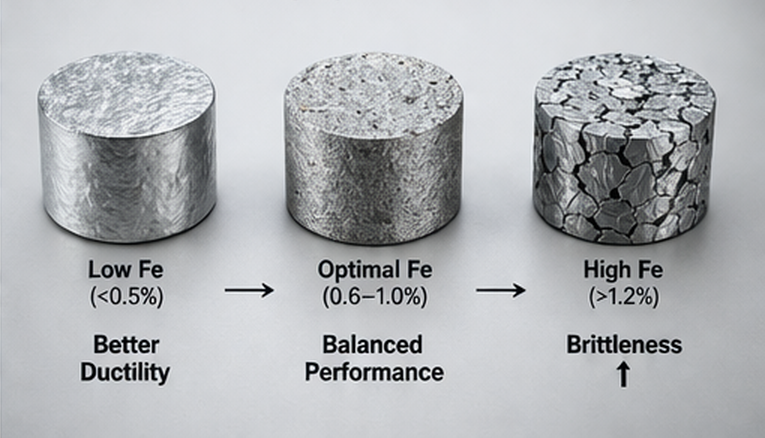
Effect of Iron Content in Aluminium Die Casting Alloys
Iron (Fe) is a critical alloying element in aluminium pressure die casting (HPDC) alloys. Unlike many impurities, iron is intentionally controlled within a defined range due to its significant impact on die life, casting behavior, and mechanical performance.
This article is based on:
- NADCA Product Specification Standards
- ASM Handbook: Nonferrous Alloys
- EN 1706 Aluminium Casting Standards
- ASTM B85
Why Iron Is Added in Aluminium Die Casting
Prevention of Die Soldering
The primary function of iron is to reduce die soldering, which is the sticking of molten aluminium to the die surface.
How It Works
Iron forms intermetallic phases that:
- Reduce adhesion between aluminium and steel dies
- Improve release characteristics
- Protect die surfaces
Without sufficient iron:
- Severe sticking occurs
- Surface defects increase
- Die life reduces significantly
Typical Iron Content in Common Alloys
| Alloy | Iron Content (%) |
|---|---|
| A380 / EN AC-46000 | 0.6 – 1.3 |
| ADC12 | 0.8 – 1.3 |
| A383 | 0.6 – 1.0 |
| A413 | 0.6 – 1.0 |
Metallurgical Behavior of Iron
Iron forms intermetallic compounds instead of dissolving completely:
- β-Al₅FeSi (Beta Phase) → plate-like, brittle
- α-Al₁₅(Fe,Mn)₃Si₂ (Alpha Phase) → compact, less harmful
Advantages of Iron in Die Casting
1. Improved Die Life
- Reduces die sticking
- Minimizes surface damage
2. Better Process Stability
- Consistent casting cycles
- Reduced downtime
3. Production Efficiency
- Less need for excessive lubrication
- Improved release behavior
Disadvantages of Excess Iron
1. Reduced Ductility
- Brittle intermetallic structures
- Lower elongation
2. Increased Brittleness
- Crack initiation sites
- Reduced impact strength
3. Machining Challenges
- Hard particles increase tool wear
Mechanical Property Impact
| Iron Level | Effect |
|---|---|
| < 0.5% | High ductility, high die sticking |
| 0.6–1.0% | Balanced performance |
| > 1.2% | Increased brittleness |
Engineering Guidelines
- Maintain Fe: 0.6% – 1.0%
- Avoid exceeding: ~1.3%
- Balance with Mn for better structure
Real Alloy Example (A380)
| Element | Role |
|---|---|
| Silicon | Fluidity |
| Copper | Strength |
| Iron | Die protection |
| Manganese | Phase control |
Conclusion
Iron is a functional alloying element in aluminium die casting:
- Essential for preventing die soldering
- Critical for maintaining production efficiency
- Harmful when present in excess
Proper control of iron, along with manganese, is key to achieving:
- Balanced mechanical properties
- High productivity
- Long die life
References
- NADCA Product Specification Standards
- ASM Handbook: Volume 2 – Nonferrous Alloys
- EN 1706 Aluminium Casting Standards
- ASTM B85
- J.A. Taylor, The Effect of Iron in Al-Si Casting Alloys