Porosity in Aluminium Die Casting: Step-by-Step Causes in Pressure Die Casting (PDC)
Porosity in Aluminium Die Casting: Step-by-Step Causes
Porosity is a critical defect in aluminium pressure die casting (PDC), directly affecting strength, surface finish, pressure tightness, and machining performance. Unlike general casting, porosity in die casting is primarily influenced by high-speed metal injection, air entrapment, and rapid solidification.
Understanding the exact sequence of how porosity forms helps in identifying its root causes.
Step-wise Causes of Porosity Formation in Die Casting
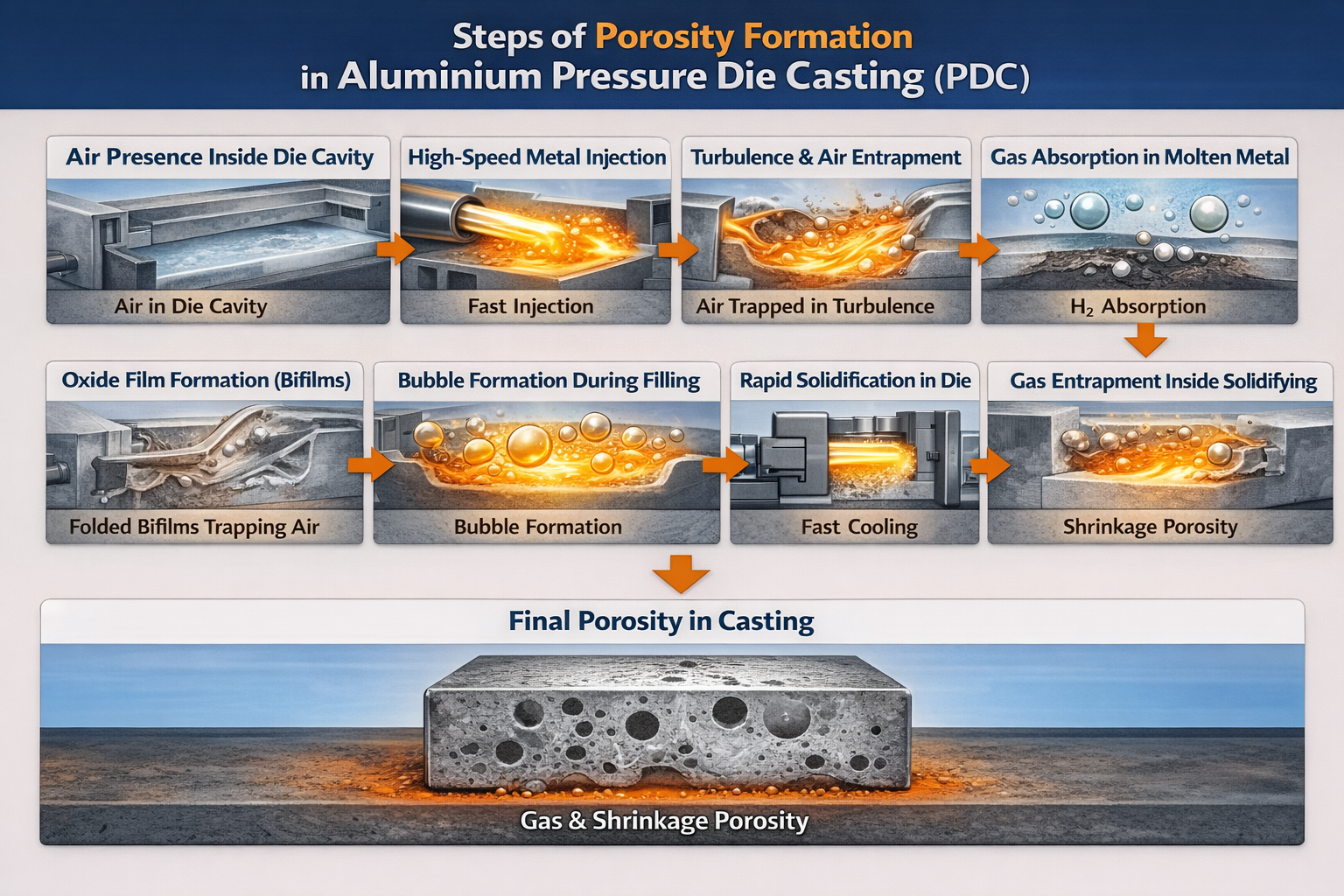
1. Air Presence Inside Die Cavity
Before metal injection, the die cavity contains air. If this air is not completely evacuated through vents or vacuum systems, it becomes a primary source of porosity.
2. High-Speed Metal Injection
Molten aluminium is injected into the die cavity at very high velocity. This rapid filling is necessary for thin sections but leads to turbulent flow.
3. Turbulence and Air Entrapment
Due to turbulent metal flow, air inside the cavity gets trapped and mixed into the molten metal instead of escaping through vents.
4. Gas Absorption in Molten Metal
Molten aluminium can absorb gases (especially hydrogen), particularly if the melt quality is not properly controlled.
5. Oxide Film Formation (Bifilms)
Turbulence causes folding of oxide layers into the melt, creating double-layered films (bifilms) that trap air and act as sites for porosity.
6. Bubble Formation During Filling
Entrapped air and dissolved gases form bubbles within the molten metal during cavity filling.
7. Rapid Solidification in Die
Die casting involves very fast cooling due to metal dies. This reduces the time available for gas bubbles to escape.
8. Gas Entrapment Inside Solidifying Metal
As the metal solidifies quickly, gas bubbles get trapped inside, forming internal porosity.
9. Shrinkage Effects (Localized)
In thicker sections, lack of proper feeding during solidification can create shrinkage porosity alongside gas porosity.
10. Final Porosity in Casting
The result is a combination of gas porosity and shrinkage porosity distributed within the casting, affecting structural integrity and performance.
Conclusion
Porosity in pressure die casting is mainly driven by air entrapment, turbulence, gas absorption, and rapid solidification. Unlike other casting processes, the high-speed nature of PDC makes controlling airflow, melt quality, and filling behavior critical to minimizing defects.